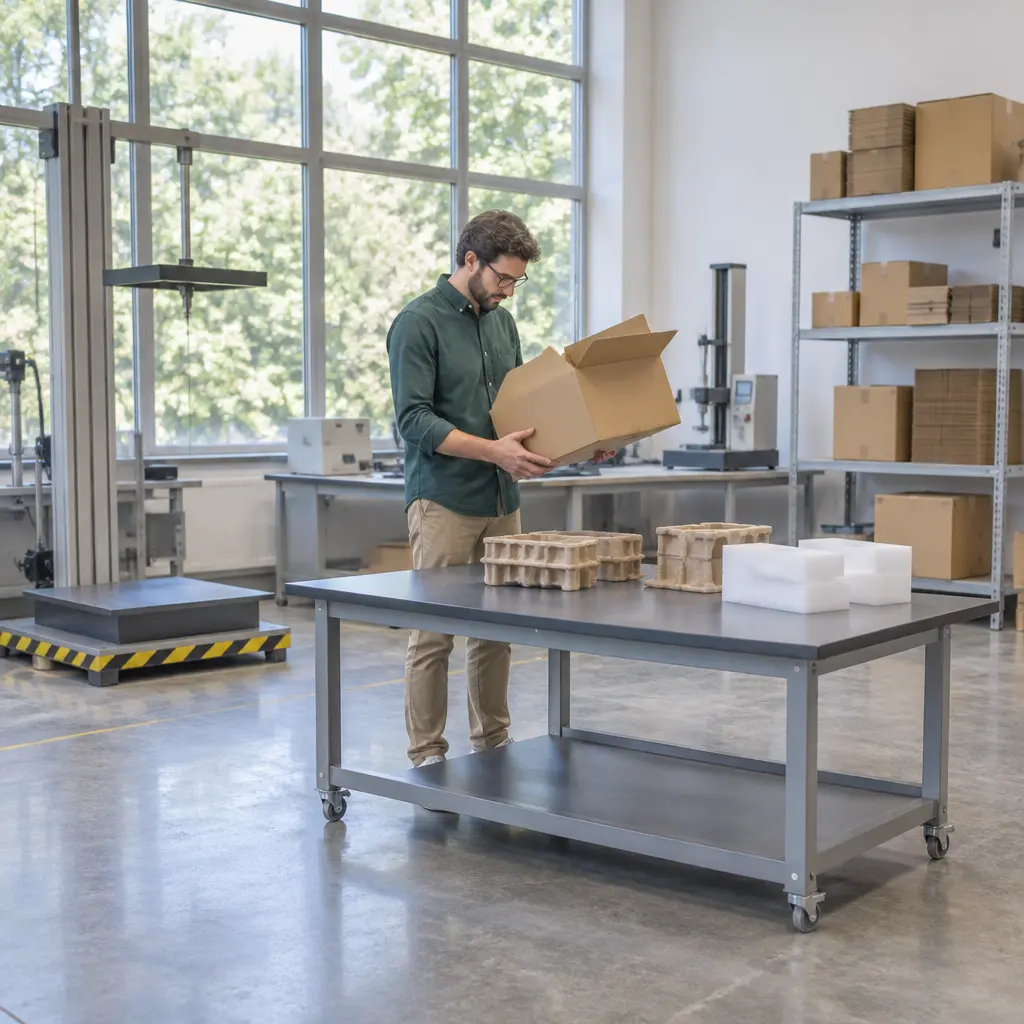
Structural packaging prototypes are early versions of boxes, inserts, and protective components designed to keep products safe through storage, handling, and transport—not merely to look appealing on a shelf. Their shipping durability is assessed through controlled tests such as vibration, compression, and drops. That distinction matters: the U.S. Environmental Protection Agency estimates that containers and packaging accounted for about 82.2 million tons, or 28.1% of U.S. municipal solid waste generation in 2018. Testing prototypes before production can help businesses balance product protection, material use, shipping efficiency, and customer-facing design.
Shipping durability defines structural packaging prototypes
A structural packaging prototype is a physical or digitally modeled package configuration created to evaluate its form, materials, fit, and performance before full-scale production. The Packaging Machinery Manufacturers Institute describes packaging development as an integration of product, package, and process requirements; in practice, a useful prototype therefore has to work with the actual product and intended distribution system, not just resemble a finished retail carton.
“Shipping durability” means the package can limit damage under the hazards expected during distribution. Those hazards can include compression from stacked loads, vibration in vehicles, impacts from drops, climatic exposure, and repeated handling. A display-only mock-up may communicate brand colors and shelf presence but cannot reliably demonstrate how a package will perform under these conditions.
The need for evidence is reinforced by the scale of parcel delivery. In its 2024 report, the U.S. Postal Service Office of Inspector General cited 22.37 billion packages delivered by the Postal Service, UPS, FedEx, and Amazon Logistics in fiscal year 2023. That volume makes packaging performance a practical concern for product protection, returns, customer experience, and material consumption.
Structural prototype categories
Common prototype types include corrugated shipping cartons, folding cartons, molded-pulp or foam end caps, dividers, trays, mailers, and unitized packs that combine a product with an outer shipper. A prototype may be a quick hand-cut sample for checking fit, a production-equivalent sample made from specified board grades, or a complete pack-out containing the product, inserts, labels, and closure method. The closer a sample is to the final production build, the more relevant its test results are to shipping decisions.
Protection, presentation, and material efficiency
A structurally sound package manages the space and materials between the product and the outside environment. Inserts can restrict movement; cushioning can reduce transmitted shock; and a correctly sized outer carton can reduce void space. Yet protection is not simply a matter of adding more material. Excess packaging can increase package dimensions, freight costs, and waste, while insufficient cushioning can raise the risk of product damage. Prototype comparisons help teams identify a design that meets performance needs without unnecessary mass or volume.
Distribution hazards guide prototype testing
Packaging tests are selected according to the product, package, and distribution route. ASTM International publishes test methods for packaging hazards, while the International Safe Transit Association (ISTA) provides procedures designed to assess packaged-product performance in distribution environments. Neither an attractive appearance nor a single successful drop demonstrates performance across every hazard; the test plan should reflect how the item will actually be shipped.
Drop and impact testing
Drop testing exposes a packaged product to controlled impacts on faces, edges, or corners. It can reveal broken components, punctures, shifted inserts, opened closures, and hidden product damage. ASTM D5276 covers free-fall drop testing of loaded containers, and ISTA procedures also include impact sequences for relevant packaged-product categories. Test height, orientation, package mass, and number of drops should follow the applicable procedure rather than an arbitrary in-house demonstration.
Vibration and compression testing
Vibration testing evaluates whether recurring movement causes abrasion, loosening, fatigue, or product-to-package contact. ASTM D4728 addresses random vibration testing of shipping containers. Compression testing evaluates the package’s ability to withstand stacking loads; ASTM D642 covers compression resistance of shipping containers, components, and unit loads. These tests are especially relevant to boxes stored beneath other freight or moved over rough routes. Results can guide board grade, flute selection, reinforcement, and pallet configuration.
Climate and environmental conditioning
Humidity and temperature can change the performance of paper-based packaging and affect sensitive products. Conditioning a prototype before testing can make the assessment more representative of storage or transit conditions. ASTM D4332 describes procedures for conditioning containers, packages, or packaging components for testing. For moisture-sensitive goods, teams may also need to consider barrier materials, seals, desiccants, or refrigerated distribution requirements.
Prototype validation links lab results to real shipments
Laboratory testing offers repeatable conditions, but a test is useful only when its setup resembles the intended shipping system. Validation typically connects package specifications, test outcomes, product inspection, and field feedback. ISTA recommends selecting a procedure based on the distribution environment and packaged-product characteristics; teams should consult the current procedure and any retailer, carrier, or regulatory requirements that apply to their product.
Build a representative test sample
A representative sample uses the intended product or a mechanically equivalent surrogate, specified packaging materials, production-style assembly, and final closure method. It should also include practical details such as labels, tape, seals, and the orientation in which the carton will travel. Testing an empty box or a hand-built sample with different materials can produce misleading results because package strength depends on construction and load as well as dimensions.
Define pass criteria before testing
Pass criteria turn observations into decisions. A team may define acceptable limits for product breakage, cosmetic damage, leakage, package opening, insert displacement, or carton deformation. For products with functional or safety requirements, inspection may include operation checks or measurements after the test sequence. Recording the package configuration, conditioning, test sequence, and findings allows designers to compare prototypes and reproduce successful results.
Use field data to refine the design
Lab results should be compared with shipping damage reports, returns, customer complaints, and distribution-center observations. A package that passes a laboratory sequence may still need revision if real-world damage clusters around a particular route, handling step, or product orientation. Conversely, a damaged prototype can identify a failure mode early, when changing an insert, seam, or carton specification is less disruptive than correcting a production run.
Case examples show why testing beyond display matters
Consider a glass appliance accessory in a retail-ready carton. A display mock-up may look polished, but drop and vibration testing can reveal that the glass contacts the carton wall after the insert shifts. The corrective action may be a revised molded-pulp cradle or divider geometry rather than a heavier outer box. For a lightweight e-commerce product, compression and vibration tests may instead show that a smaller carton and better restraint provide adequate protection while reducing void fill.
These examples illustrate a general design principle: test the complete shipping configuration, not isolated materials or an empty package. A corrugated grade can meet a paper specification yet fail as part of a carton if its dimensions, closures, loading pattern, or environmental exposure differ from the test conditions. Packaging performance is a system outcome.
Conclusion: test prototypes for the journey, not just the shelf
Structural packaging prototypes are valuable when they represent the final pack and are assessed against realistic distribution hazards. Drop and impact tests examine shock resistance; vibration tests assess movement-related failure; compression tests address stacking; and environmental conditioning helps account for temperature and humidity. Clear pass criteria and real-shipment feedback turn these tests into practical design decisions.
With packaging representing a substantial share of municipal solid waste and parcel networks moving billions of packages annually, durable and right-sized designs matter beyond appearance. Product teams should involve packaging engineers early, choose test methods suited to their distribution route, and revise prototypes before production. For further guidance, consult current ASTM and ISTA procedures and verify any requirements imposed by carriers, retailers, and regulators.
Sources: U.S. Environmental Protection Agency, “Containers and Packaging: Product-Specific Data,” https://www.epa.gov/facts-and-figures-about-materials-waste-and-recycling/containers-and-packaging-product-specific-data; U.S. Postal Service Office of Inspector General, “The Last-Mile Delivery Challenge,” 2024, https://www.uspsoig.gov/reports/white-papers/last-mile-delivery-challenge; ASTM International, ASTM D5276, Standard Test Method for Drop Test of Loaded Containers by Free Fall, https://www.astm.org/d5276-19.html; ASTM International, ASTM D4728, Standard Test Method for Random Vibration Testing of Shipping Containers, https://www.astm.org/d4728-17.html; ASTM International, ASTM D642, Standard Test Method for Determining Compressive Resistance of Shipping Containers, Components, and Unit Loads, https://www.astm.org/d0642-20.html; ASTM International, ASTM D4332, Standard Practice for Conditioning Containers, Packages, or Packaging Components for Testing, https://www.astm.org/d4332-22.html; International Safe Transit Association, Test Procedures, https://ista.org/test_procedures.php; Packaging Machinery Manufacturers Institute, Packaging and Processing: A Guide to the Industry, https://www.pmmi.org/.